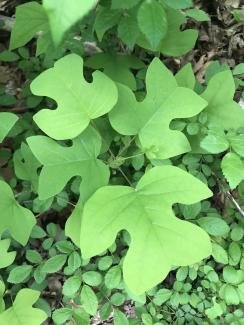
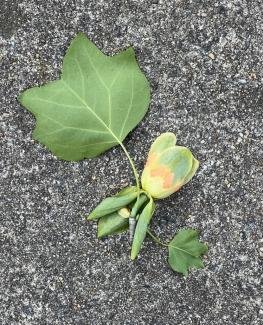
Habitat: The tulip poplar is found naturally in mesic forests, cove forests at least 1500 feet in elevation, bottomland forests, and swamps
Wildlife value: Supports pollinators and is a larval host plant for the Eastern Tiger Swallowtail (Papilo glaucus), Spicebush Swallowtail (Papilio troilus) and Viceroy (Limenitis archippus). Hummingbirds, butterflies, bees, and birds like cedar waxwings feed on the nectar from flowers. White-tailed deer, gray squirrels, and some songbirds eat the flowers in the spring. Sprouts, buds, and seeds are primary food for deer and squirrels. Plant NOVA Natives lists this species as particularly popular with the non-native honeybees
Notes: Common throughout the Mid-Atlantic Region, Tuliptree is aptly named from the shape of its flowers and leaves to the samara whorls persisting like wooden tulips until spring. It is an excellent shade or ornamental tree for a large property, sited best on lower or concave slopes. Long-lived, fast-growing, tall and straight-trunked deciduous tree.
Insects, Diseases, or Other Plant Problems: This plant has pest and disease problems. Pests include scale and aphids. Large aphid infestations result in honeydew secretions on the leaves that provide the growing medium for sooty mold. Verticillium wilt, mold, powdery mildew, leaf spots, and canker are possible diseases. Fast-growing means they are weak-wooded and susceptible to limb breakage in high winds or from ice/snow.
Edibility: The root is used as a lemon-like flavouring in spruce beer, where it also serves to correct the bitterness of the beer.
Earth Sangha Inventory
Founded in 1997, the Earth Sangha is a nonprofit public charity based in the Washington, DC, region. The Wild Plant Nursery is the most comprehensive source of local-ecotype, native plants in the Washington DC region, and the region’s only facility dedicated exclusively to this type of propagation. “Local-ecotype” plants are propagated from local, wild, naturally-occurring populations and are well-adapted to local conditions and for wildlife species that depend on the local forms, such as pollinators. Inventory is updated on a weekly basis so number may not be accurate.
| Pots Available | Plugs Available | Location | Notes | ||
|---|---|---|---|---|---|
| 1 | 0 | Row 14 | View My Wishlist |
Carniola Farms Nursery
Nursery operates Arlington Native Plants & Edibles located at 925 N. Madison St. Arlington Virginia 22205. Plants can be purchased at any time by making an email appointment at carniolafarms@gmail.com. Also, during the during the planting season, they are open some Saturdays from 11AM to 3PM. Check their website for datesThis plant list is from the beginning of the 2025 season and may be out-of-date
| In Stock? | Notes | ||
|---|---|---|---|
| Yes | View My Wishlist |
Beloved Brook's Ruckersville Nursery Inventory
Nursery is open by appointment only. Email them to set up a time. This plant list if from the begging of the 2025 season and may be outdated. If there is something specific that you’re looking for, they recommend you confirm that they have it when you schedule an appointment
| Pots Available | Plugs Available | Pot size: | ||
|---|---|---|---|---|
| Yes |
Gallon |
View My Wishlist |
Bona Terra Nursery
Small family-run native plant nursery with a focus on the local genetics necessary to restore diversity in the Chesapeake eco-region. Offers free remote design service for small gardens up to 400 square feet. Orders are placed via email and items can be picked up at their NW DC office or delivered for a fee. This plant list is from the beginning of the 2025 season and may be out-of-date
| Pots Available | Pot Size | Notes | Add to Wishlist | |
|---|---|---|---|---|
| 5 | Quart | View My Wishlist | ||
| 4 | 3 Gallon | View My Wishlist |