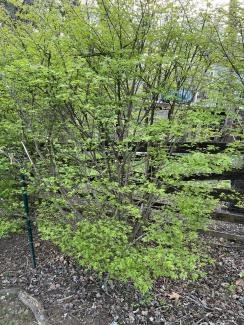
Notes: This shrub is very popular and is widely used in commercial and residential landscapes and as a roadside hedge. By forming dense thickets, it alters the structure of native forest communities and is now considered invasive along much of the East Coast, including Alexandria and Arlington, Virginia.
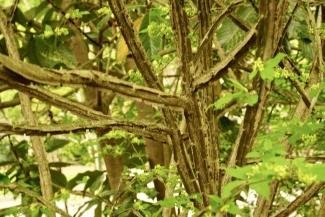
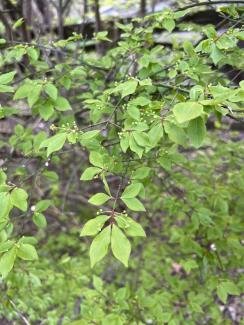
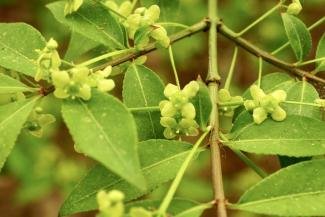
Identification: Seedlings and young plants show bright green leaf buds, often with pink at the base. Leaves grow opposite or nearly opposite along slender stems, which often (but not always) display corky ridges or “wings” as the plant matures. In fact, the species name alatus means winged. Leaves are simple and oval with smooth edges.
Native lookalikes: Burning bush can resemble the native strawberry bush (Euonymus americanus) and Eastern wahoo (Euonymous atropurpureus). These three plants are easy to distinguish by their flowers and fruit capsules.
Spread: Birds eat the fruits and disperse seeds, but they may also move with water or in soil carried on vehicles, equipment, and footwear.
Method of removal:
- Seedlings - Seedlings and young plants can be hand-pulled or pried up with a garden fork in moist soil.
- Shrubs - Difficult to uproot because of plant's deep fibrous root system. Best cut close to the ground in summer or fall and the cut surface painted immediately with herbicide.
Additional Note: MGNV's Suggested replacement: Rhus aromatica is the "Gro-Low" cultivar (Rhus aromatica ‘Gro-Low’ (Fragrant Sumac))